

Before You Buy a New Mattress for Your Back Pain, Read This.

"What mattress should I buy?"
I get asked this almost as often as I get asked about posture. Usually by someone who's been putting up with back pain for months and has decided the bed must be the culprit.
Sometimes they've spent thousands on a brand new mattress and have come to see me frustrated because it made no difference. Some of them feel worse.
Here's what I tell them.
Your mattress and your sleeping position matter. There's real research behind both, and I'll walk you through what it actually says. But they're the eight hours. The other sixteen are what built the problem in the first place.
This isn't a list of mattress recommendations with affiliate links. It's the honest version of what the evidence shows, what it doesn't, and where sleep actually fits into the bigger picture.
If you’ve been searching for the best mattress for back pain and landed on firm, that advice was wrong
Let's start with the one piece of advice almost everyone has heard. "Get a firm mattress, it's better for your back."
This is a myth! And we've known that for over twenty years.
In 2003, researchers published a trial in The Lancet involving 313 adults with chronic lower back pain. Half were given firm mattresses. Half were given medium-firm. Nobody knew which they'd received.
After 90 days, the medium-firm group did better across the board. They had less pain lying in bed, less pain getting up in the morning, and better scores for day-to-day disability. The odds of improvement were more than double.
A later systematic review of 24 controlled trials reached the same conclusion. Medium-firm surfaces came out best for comfort, sleep quality, and keeping the spine aligned.
So if you bought a firm mattress because someone told you to, that advice was wrong. And if it made you feel worse, you're not imagining it.
Why medium-firm wins
It comes down to keeping your spine properly supported while you sleep.
A mattress that's too soft allows your hips and shoulders to sink too deeply, causing your spine to curve out of its natural alignment.
A mattress that's too firm creates the opposite problem. It pushes your hips and shoulders upward, leaving gaps between your lower back and the mattress. Without proper support, your body struggles to maintain a comfortable, neutral position throughout the night.
Medium-firm sits between those two problems. It gives enough so your shoulders and hips settle in. It supports enough that your spine stays roughly level.
That's the key principle: your mattress should support the natural shape of your spine, keeping it properly aligned without creating unecessary stress in different areas or leaving unsupported gaps

What type of bed should you actually buy?
Firmness matters more than material. But material affects how that firmness feels and how long it lasts, so here's the practical version.
Hybrid mattresses combine springs with a foam comfort layer. For most people with back pain, this is the safest bet. You get support from the springs and contouring from the foam, and they tend to sleep cooler than all-foam.
Memory foam contours closely, which suits side sleepers and people with pressure point pain. The trade-offs are heat retention and the sinking feeling some people dislike. Higher density foam holds its shape longer.
Latex is responsive, durable, and sleeps cooler than memory foam. It's usually the most expensive option, but it also lasts the longest. Good choice if you want firm support without the dead feeling of foam.
Traditional innerspring is the cheapest option and the one most likely to sag. If you go this route, look for pocketed coils rather than a connected spring unit, since they move independently and transfer less motion.
Three practical rules regardless of type:
Replace it if it's over eight to ten years old, or if you can see a visible dip where you sleep. A sagging mattress has already stopped doing its job.
Test it for at least ten minutes in your actual sleeping position, not sitting on the edge. Most retailers also offer trial periods now, which is far more useful than a showroom test.
If you share a bed with someone much heavier or lighter, consider a split or dual-firmness option. One firmness rarely suits two very different bodies.
What about sleeping position?
Here's where I'm going to be more careful than most articles you'll read on this.
The evidence for mattress firmness is genuinely good. The formal research on sleeping position is thinner, and a lot of what gets quoted online comes from mattress companies rather than studies.
But thin research doesn't mean we know nothing. Some of this is just mechanics.
Stop sleeping on your stomach
This is the one position I'll actively tell people to change.
To breathe on your stomach, you have to turn your head all the way to one side. Then hold it there for six or eight hours. That's your neck at the end of its range, under load, all night.
No other sleeping position asks that of you.
It doesn't stop at the neck either. Your stomach sinks into the mattress, which pulls your lower back into an arch and holds it there.
So you've got sustained rotation at one end of your spine and sustained extension at the other. For roughly a third of your life.
In my clinic, stomach sleepers are consistently the people with the stiffest necks and the most stubborn morning pain. When they change position, things usually improve.
If you're a stomach sleeper, start by lying on your side and hugging a pillow to your chest. It gives you something to press against, which is usually what stomach sleepers are chasing.
Most people take two or three weeks to adjust.
Back and side sleeping are both fine
Both let your spine sit in a neutral position. Neither is clearly better than the other, so pick whichever you find comfortable.
If you sleep on your side, put a pillow between your knees. Without it, your top leg drops forward and rotates your pelvis and lower back all night.
If you sleep on your back, put a pillow or two under your knees. It takes pressure off your lower back and helps your spine settle.
One more thing. If you've slept on your side the same way for thirty years and you're comfortable, I'm not going to tell you to change it. Stomach sleeping is the exception, and it's worth the effort of breaking.
Your mattress might not be the only problem
Most people spend serious money on a mattress and then sleep on a pillow they've had for six years.
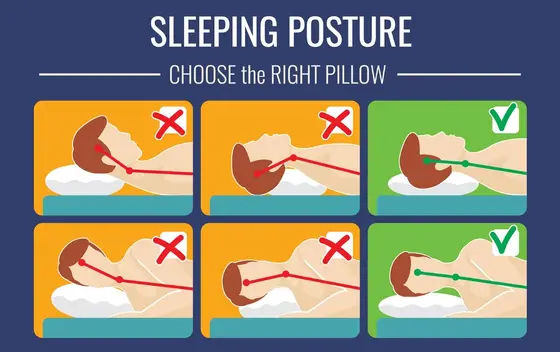
Pillow height is simple to get right once you know the rule.
Side sleepers need a higher pillow. It has to fill the gap between your ear and the mattress, which is roughly the width of your shoulder. Too flat and your head drops toward the mattress all night.
Back sleepers need a lower pillow. Enough to support the curve of your neck, but not so much that your chin is pushed toward your chest.
Stomach sleepers need almost nothing. A very thin pillow or none at all, because any height adds extension on top of the rotation already happening.
Here's the test I give people. Lie in your usual position and have someone photograph you from the side. Your nose should line up roughly with the centre of your chest. If your head is tilted up or dropping down, the pillow height is wrong.
The part that actually matters
Now the honest bit.
A good mattress is like a good pair of shoes. They help. They reduce load, they make things more comfortable, and the wrong ones genuinely make things worse.
But no shoe fixes a limp.
If you wake up sore every morning, the bed is worth checking. If you've already changed the bed, changed the pillow, tried every position, and you're still sore, the surface was never the problem.
What happens overnight is largely a reflection of what's happening the rest of the time. If the curves in your spine have changed, load gets concentrated at specific levels. A meta-analysis of 13 studies found a strong link between a reduced lower back curve and lower back pain. A separate study found loss of the neck curve in roughly 42% of people with neck pain.
Eight hours on a better surface doesn't undo sixteen hours of load going through a spine that isn't sitting where it should.
That's not a reason to ignore your bed. It's a reason not to stop there.
Three things to try before investing in a new mattress
None of these cost anything.
Match your pillow to your sleeping position: Higher for the side sleeper, lower for sleeping op on your back, almost none for stomach. Use the photo test to check.
Tweak your sleeping position: Between the knees if you're a side sleeper, under the knees if you're on your back. Avoid stomach sleeping. This is the single easiest change most people haven't made.
Check your mattress for a dip. Pull the sheets back and look across the surface at eye level. If you can see a hollow where you sleep, the mattress has given up, whatever the label said when you bought it.
Give these a fortnight. If your morning pain improves, the bed was part of it. If nothing changes, that tells you something useful too.
Where to start: back pain and sleep in Clyde North
If you're waking up sore most mornings and you've already tried changing the bed, the problem probably isn't the bed.
That's what our ClearSpine Pain Assessment is built to answer. We perform five targeted tests designed to find what's actually driving your symptoms. They show where load is concentrating and what the path forward looks like.
I see people from across Melbourne's southeast, including Berwick, Cranbourne, Narre Warren, Officer and Beaconsfield, here at the clinic in Clyde North.
If you're ready to find out what's really going on, book your ClearSpine Pain Assessment or call us on (03) 5915 9895.
Finding the best mattress for back pain helps. Finding out why your back hurts helps more.

(An important note: some back pain needs medical assessment, not a new mattress. See your GP if it wakes you every night, comes with unexplained weight loss or fever, or follows significant trauma.)
Dr. Ashley Cherrett (BAppSc(Chiro), BHlthSc) is the principal chiropractor and Director of Cherrett Chiropractic in Clyde North, Melbourne. He practises using the Chiropractic BioPhysics (CBP) technique, a structured, evidence-based approach to spinal correction. This article is educational and does not constitute medical advice. Individual results vary, and all care is based on individual assessment.


Comments